
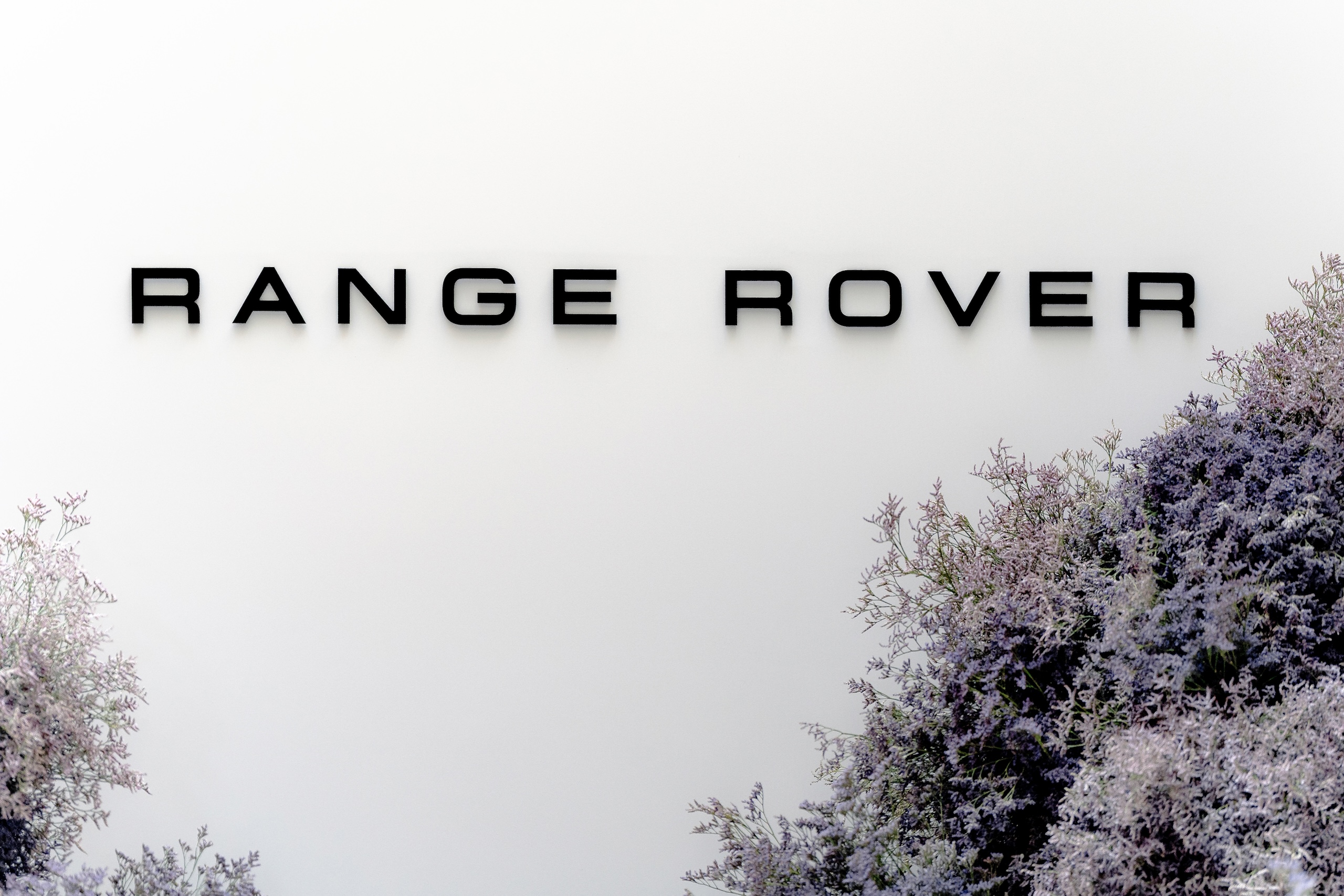
Range Rover has introduced a new visual motif and a redrawn wordmark as part of Jaguar Land Rover’s strategy to build a “house of brands.”
Owned by Tata and based in Warwickshire, JLR’s portfolio comprises Range Rover, Defender, Discovery and Jaguar. It wants to create four distinct brands, each with its own positioning and marketing strategy.
“We don’t have any brands, they’re just four names at the moment,” JLR’s design director Richard Stevens told us last year. “Range Rover is the closest thing we have to a brand.”
The old Range Rover wordmark (left) next to the new one
The new work for Range Rover began two years ago, well before the launch of the much-talked about Jaguar rebrand, explains brand design chief Will Verity.
He and his team have been “decoding and recoding Range Rover’s existing DNA into a set of guidelines that support modern luxury communication.”
The aim is to celebrate the fact that Range Rover, which was launched in 1970 by British Leyland, was the first automotive brand to combine utility and luxury.
Verity, who joined Range Rover from Map Project Office last October, called Range Rover’s original mark “bold, confident and quite elegant,” but he said that, “bits of it were quite weird.”
Every letter of that original mark has been recrafted for the new wordmark.
“We’re trying to revive the character of the 1970s mark, while translating it into a more confident, contemporary expression of the brand,” he says.
A label on the Range Rover London collection
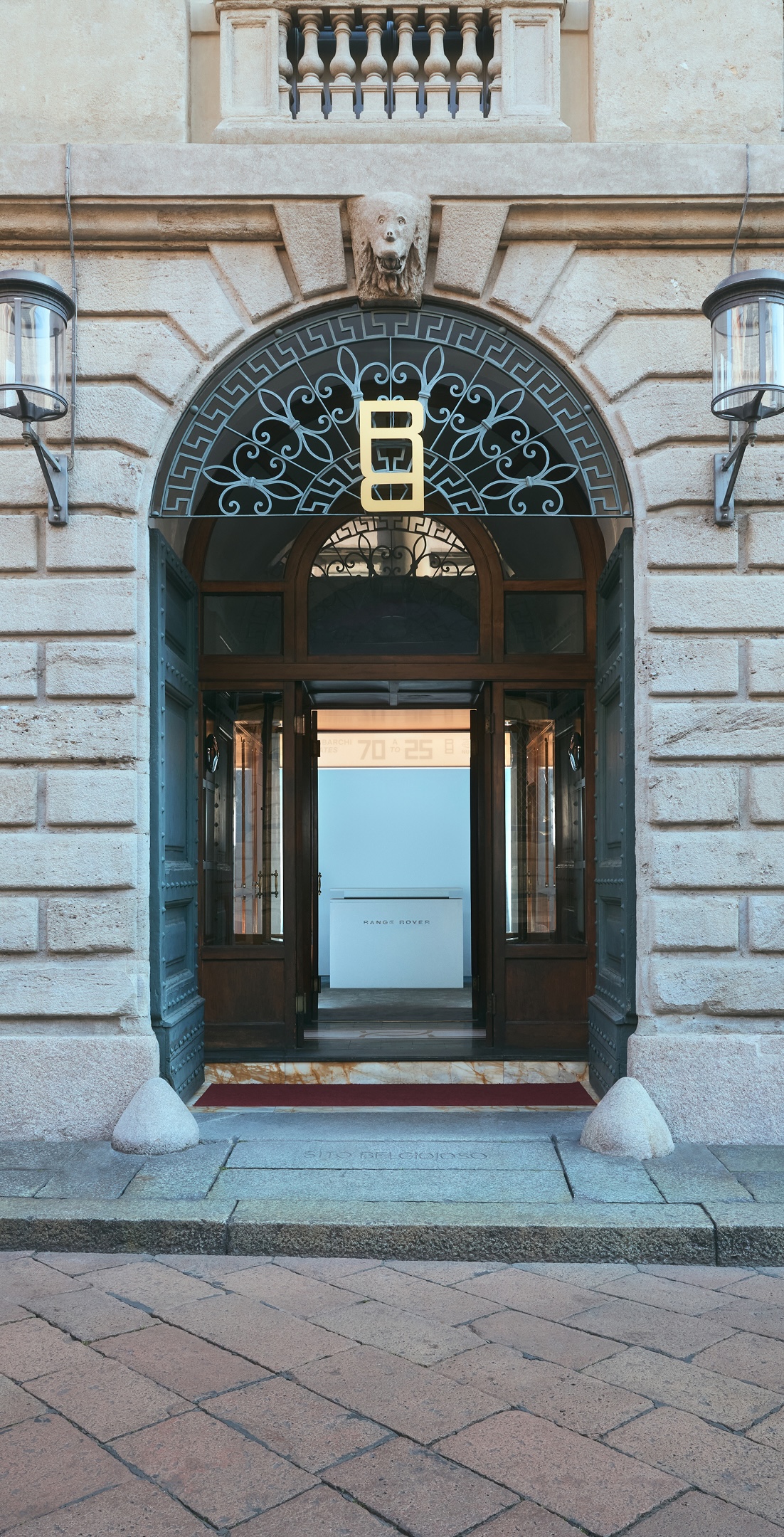
Verity and his team have also introduced a new visual device that acts as a shorthand for the brand, to be used in small spaces like a label or a social media image.
It comprises two connected Rs – one upside down – playing on the letter’s tension between a sharp corner and a radius edge. Verity suggests this could work in retail signage and on apparel, and could be extrapolated into a pattern.
“It’s not revolutionarily different from where we were, but hopefully it just feels a little bit more sophisticated, more elegant and a more consistent, coherent approach to where we’re moving to, in terms of luxury positioning,” he says.
Range Rover is just the latest in a swathe of brand changes among high-end car manufacturers.
Most recently, Bentley revealed a simplified logo. Before that came Jaguar’s audacious repositioning, and Rolls-Royce, Lamborghini, Porsche, Lexus, Aston Martin, BMW and Audi have refreshed their identities in recent years.
Middle-of-the-road brands have got in on the act too – Toyota, Peugeot, Kia, Volvo and Nissan all introduced new or tweaked visual identities in the early years of this decade.
All of these companies are responding to a host of challenges, most pressingly the rise of electric vehicles – often produced by new makes such as Polestar, Rivian and Rimac – which has blown apart the old rules.
The new Jaguar logo, by Jaguar Land Rover’s in-house design team
In June, 47,354 EVs were registered in the UK, just under one in four of all new car sales (24.8%). That’s up more than a third compared with June last year, although sales haven’t yet hit the government’s target of 28%.
The glut of new EV brands has fundamentally changed the car-buying landscape.
“It has posed a question to the existing brands,” Verity explains. “What is your unique positioning in the world? What is your heritage? Where have you come from, and why?”
Couple that with the fact most car brands were not designed to work on digital touchpoints, and “change needed to happen,” says Pentagram partner Marina Willer.
Luxury models in particular needed to rethink their digital expression, because “they offer more sophisticated UI experiences and need the brand tools to do so,” Willer says.
Pentagram’s new identity for Rolls-Royce in 2020
She saw this first-hand when her team rebranded Rolls-Royce in 2020.
“We worked to give the brand the simplicity needed for the digital world, combined with texture, depth and sophistication,” she explains.
Then there’s the audience shift. Many luxury care brands want – and need – to attract younger audiences, and diversify the sort of people who see themselves behind the steering wheel.
As part of their work, Willer says they wanted to shift Rolls-Royce, “from a masculine world into a much more inclusive brand.”
And as the target customers change, so too do the visual codes that have long underpinned the high-end car brands.
“The signals of luxury that once worked – power, prestige, design purity – don’t really land the same way today,” says Will Bosanko, UK & Europe CEO at brand consultancy Brandpie. “A new generation won’t buy the badge unless it means something, or fits how they live.”
That’s what seemed to be lost in the Jaguar furore when it unveiled its new identity last autumn. A common criticism – that it didn’t look anything like Jaguar – was, the company insisted, sort of the point.
But it’s a complicated balance to strike.
These brands need to work out how to look future-focused and relevant while wondering how – maybe even if – to accommodate the heritage they’ve spent decades trumpeting.
“These brands are standing at a crossroads – legacy equity on one side, future irrelevance on the other,” Bosanko says.
Pentagram’s new identity for Rolls-Royce in 2020
Many find a solution in a similar visual approach – “more direct, simple and digital-first,” as Willer puts it. But, she warns, this can start to feel samey.
Bosanko goes further. “It’s all starting to blur. Flat, soft, sanitised,” he says.
“In chasing modernity, these brands are erasing the very things that made them distinctive. Somewhere along the way, ‘minimal’ became shorthand for ‘strip it all away’.”
Not every brand though has gone all-in on a new look. Sebastian Conran, chair of Conran and Partners, points out that Ferrari hasn’t been touched – yet. “Perhaps because the prancing horse has got so much invested in it,” he says.
The luxury car brand pivot
A couple of weeks ago, Bentley unveiled a simplified logo, based on a concept by one of its interior designers, Young Nam. Bentley called this latest iteration “the biggest change to the instantly recognisable mark in more than a century of history.”
The new Winged B emblem designed to channel the spirit of the 1919 original
Last year, Jaguar’s new in-house branding aimed to radically reposition the make, whose future vehicles will be 100% electric and around twice as expensive as current models. Due to the outcry, it was one of those rare design stories that crashes the mainstream news bulletins. But recent reports that its sales had tanked as a result of the rebrand were wrong – JLR had stopped selling cars in preparation for the new models.
Earlier last year, Lamborghini’s redesign featured a tweaked wordmark and the introduction of gold as an accent colour. The charging bull at the centre of the logo now exists on its own on the company’s digital touchpoints, separated from the black shield. The redesign also includes a new set of icons, developed in collaboration with Lamborghini Centro Stile.
The redrawn Lamborghini logo
Porsche modernised its crest for its 75th anniversary in 2023. “We have reinterpreted historical characteristics and combined them with innovative design elements such as a honeycomb structure and brushed metal,” its chief designer Michael Mauer said at the time. “The result is an aesthetically ambitious arc that bridges the history and the future of the brand.”
Peter Saville refreshed Aston Martin’s logo in 2022. “The Aston Martin wings update is a classic example of the necessary evolution of logotypes of provenance,” Saville told Dezeen.
That same year, Lexus announced that its vehicles would now sport a simple Lexus wordmark on the back, instead of its angled L in a roundel.
In 2020, Pentagram created a new identity for Rolls-Royce, in an effort to modernise the brand and appeal to a more diverse audience.
Pentagram’s work included a new wordmark and typeface, and a refined version of the brand’s Spirit of Ecstasy symbol.
Also in 2020, BMW reworked its metallic emblem with a black outer ring in favour of a transparent, flat, minimal version with help from Munich studio BECC Agency.
And in 2017, Audi – perhaps ahead of the game – was given a new visual identity by German design consultancy Strichpunkt, which aimed to make it a digital-first brand, and help it function better across online platforms, including in-car interfaces.